Growth Doesn’t Disappear During a Downturn. It Moves.
- John Stevenson

- 2 days ago
- 8 min read

What Canada’s Recession Debate Is Missing and Why the Smartest Brands Are Looking Beyond the Headlines
This morning, as I was having my coffee and reading The Globe and Mail, one headline caught my attention.
Canada’s economy contracted for a second consecutive quarter, reigniting debate over whether the country is entering a recession. Economists remain divided. Some cite weakening business investment, elevated unemployment, and slowing growth as evidence that the economy is losing momentum. Others argue that the decline is too modest and uneven to constitute a true recession.
It’s an important discussion.
But as I read through the article, I found myself thinking that for many business leaders, it may not be the most important discussion.
Whether Canada is technically in a recession is ultimately a question for economists. They will debate the data, compare historical benchmarks, and eventually decide whether the label fits.
Business leaders face a different challenge. Their job is not to determine whether the economy meets a textbook definition of recession. Their job is to understand how markets are changing and where future growth will come from.
Those are not always the same thing.
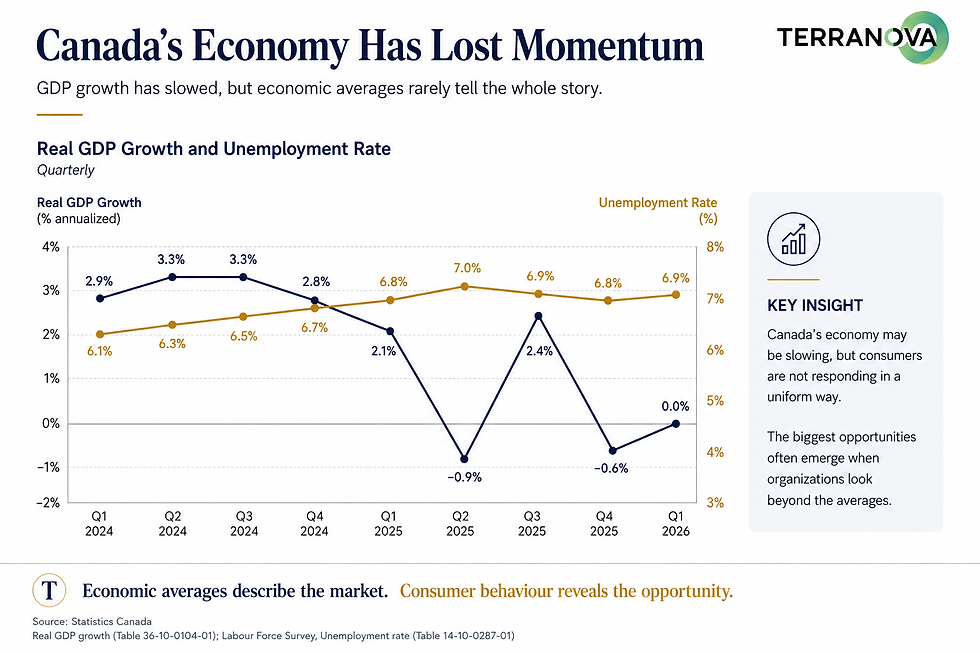
In fact, some of the biggest strategic mistakes I have seen organizations make occur when leadership teams become so focused on economic headlines that they stop paying attention to what is actually happening with consumers.
When uncertainty rises, many organizations instinctively become defensive. Marketing budgets are scrutinized. Research projects are postponed. Innovation initiatives are delayed. Hiring slows. Expansion plans are reconsidered. Every expenditure is placed under a microscope.
There is nothing inherently wrong with discipline. Strong leaders should be thoughtful stewards of resources, particularly during periods of uncertainty.
The problem arises when cost management becomes the strategy.
Because history shows us that economic slowdowns rarely affect every consumer equally, every category equally, or every opportunity equally. What often changes during a downturn is not the existence of demand. What changes is where that demand exists, how consumers express it, and which organizations are best positioned to capture it.
Over the course of my career, I have learned a simple but powerful lesson:
Growth doesn’t disappear during a downturn. It moves.
The organizations that emerge strongest are often the ones that recognize where it is moving before their competitors do.
A Lesson from the Sales Floor
I learned this lesson long before I entered the world of consulting and market research.
Years ago, I was leading the menswear business at Holt Renfrew’s Yorkdale location during a period marked by economic uncertainty and the introduction of the Harmonized Sales Tax (HST) in Ontario.
For luxury retailers, the mood was anything but optimistic. Consumers were nervous.
Cross-border shopping was becoming increasingly attractive. Many affluent shoppers were looking south for purchases that they believed offered better value.
The prevailing assumption across much of retail was straightforward: luxury spending would decline and growth would become harder to find. On the surface, there was evidence to support that view. Traffic patterns were changing. Some long-time customers were spending less. Others were choosing to make purchases in the United States rather than Canada. Every conversation about the future seemed to begin with concern about what might be lost.
Yet as I spent time on the sales floor, speaking directly with customers and observing shopping patterns, I began noticing something that didn’t fit the dominant narrative.
While some customers were clearly pulling back, others were not.
In fact, a number of customers were spending more.
The demographics of the shoppers entering Yorkdale were changing. The communities surrounding the mall were evolving. The luxury vehicles arriving in the parking lot reflected a customer profile that looked different from the one many of our plans were built around.
At the same time, our merchandising strategy remained largely focused on the customer who had driven success in the past. The more I looked at the situation, the more I became convinced that we weren’t simply experiencing a decline in demand.
We were experiencing a shift in demand. The market was changing faster than our assumptions.
As a result, we began making adjustments. We strengthened selected premium suit categories, expanded higher-end accessory offerings, and rebalanced merchandise toward products that better aligned with the emerging customer profile we were observing.
This wasn’t driven by a multimillion-dollar research study. It came from curiosity.
It came from paying attention. It came from conversations with customers.
It came from observing behavioural changes before they appeared in a report.
And it worked.
Despite the broader economic pressures facing the market, our menswear department became one of the few areas to exceed budget expectations.
Looking back, one realization stands out above all others.
We weren’t losing customers. We were missing customers. That distinction may seem subtle, but it fundamentally changed how I think about growth.
When leaders believe customers are disappearing, they focus on defense. When leaders recognize that customers are shifting, they focus on discovery.
One mindset protects the status quo. The other creates opportunity.
The Danger of Thinking in Averages
One of the reasons organizations struggle during uncertain economic periods is that they become overly reliant on averages:
GDP growth, consumer confidence. Inflation, Unemployment, Retail sales, Housing starts.
These indicators are important, but they tell only part of the story. The challenge is that consumers do not behave like averages. An economy may be slowing while a particular consumer segment is accelerating. A category may be struggling while a subcategory is thriving. A retailer may be under pressure while a competitor captures significant new demand.
The broader economy may be stagnant while an emerging consumer group creates entirely new opportunities. Economic headlines tend to compress millions of individual decisions into a single number. Markets are far more nuanced.
When organizations focus exclusively on averages, they risk missing the very shifts that create competitive advantage.
This is particularly important today because Canada is not experiencing a uniform economic story. Different regions are evolving differently. Different demographic groups are responding differently. Different industries are facing different realities. The opportunity is often hidden beneath the average.
History Continues to Reward Those Who See the Shift
Business history is filled with examples of organizations that succeeded during downturns not because they ignored economic reality, but because they recognized behavioural shifts before their competitors.
One of the most frequently cited examples is the battle between Kellogg’s and Post during the Great Depression. As economic conditions deteriorated, Post reduced advertising expenditures. Kellogg’s moved in the opposite direction, investing aggressively behind Rice Krispies and increasing visibility while competitors retreated.
The outcome was dramatic. Kellogg’s strengthened its market position and emerged from the Repression as the category leader. The lesson, however, is often oversimplified. Many people interpret the story as proof that companies should simply spend more during downturns.
That misses the deeper insight. Kellogg’s wasn’t successful because it spent money.
It was successful because it recognized an opportunity to gain relevance while competitors became invisible. Advertising amplified the strategy.
It didn’t create the strategy.
The same pattern can be observed decades later.
During the early 1990s recession, Taco Bell and Pizza Hut continued investing while competitors became more cautious. During the 2008 financial crisis, retailers such as TJ Maxx successfully repositioned themselves around evolving consumer definitions of value.
During COVID-19, Procter & Gamble continued investing in brand building while many organizations dramatically reduced their presence. In each case, the winning organizations did more than maintain investment. They recognized that consumers were changing. Their strategies evolved alongside those changes.
Why “Don’t Cut Marketing” Is Not Enough
Whenever economic uncertainty emerges, marketers inevitably begin sharing a familiar message:
“Don’t cut marketing.”
There is truth in that advice.
But it is incomplete.
Maintaining investment only works if you understand where to invest. If the market is shifting, yesterday’s assumptions may no longer be valid. A brand can spend millions communicating to the wrong audience. A retailer can invest heavily in the wrong category. A manufacturer can increase promotion behind products that no longer align with consumer priorities.

The issue is not simply investment. The issue is insight. The organizations that outperform during periods of uncertainty tend to ask different questions.
Rather than asking, “How do we protect our market share?”
They ask:
“How is the market changing?”
“Which consumers are changing fastest?”
“What new needs are emerging?”
“What opportunities are our competitors overlooking?”
Those questions create growth.
Canada’s Hidden Growth Markets
This is where I believe many Canadian organizations face their greatest blind spot.
Too many leadership teams are looking at the economy through a national lens while growth is increasingly being created through demographic, cultural, and behavioural shifts occurring at a local level.
Canada today is dramatically different from the Canada of even ten years ago.
Population growth has transformed communities. Immigration has reshaped neighbourhoods. Household structures have evolved. Consumer expectations have changed. The country’s fastest-growing communities often look very different from the traditional consumer profiles that many organizations continue to target.
Yet despite these changes, many businesses continue allocating resources based on outdated assumptions.
They understand inflation.
They understand interest rates.
They understand GDP.
What they often fail to understand is how quickly consumer behaviour is evolving underneath those macroeconomic trends. Some of the fastest-growing opportunities in Canada today exist within segments that remain underserved by mainstream marketing, product development, and retail strategies.
That doesn’t mean every organization needs a multicultural strategy. It means every organization needs a consumer strategy grounded in current reality rather than historical assumptions.
Why Research Matters More During Uncertainty
One of the most surprising responses to economic uncertainty is how frequently organizations reduce investment in research and insights. From a strategic perspective, this is often exactly backwards. The purpose of research is not to confirm what we already know. The purpose of research is to understand what is changing.

And periods of disruption are precisely when consumer behaviour changes most rapidly:
Consumers reassess priorities.
Shopping habits evolve.
Value perceptions shift.
New needs emerge.
Old loyalties weaken.
If ever there is a time to increase curiosity, it is during uncertainty. The worst time to rely on yesterday’s assumptions is when tomorrow’s consumer is already arriving.
Organizations that continue investing in understanding their customers gain an enormous advantage. They identify emerging opportunities earlier.They detect threats faster.And they make decisions based on evidence rather than fear.
The TerraNova360 Perspective
At TerraNova360, we have built our Integrated Growth Blueprint™ around a simple observation. Growth opportunities rarely disappear. They move.
Our role is to help organizations identify where they are moving and how to position themselves to capture them. That process begins with understanding consumers.
It involves examining behavioural shifts, demographic changes, shopper journeys, competitive dynamics, and emerging opportunities that may not yet be visible through traditional reporting.
Sometimes the answer involves a new audience.
Sometimes it involves a new positioning strategy.
Sometimes it involves a new purchase occasion.
Sometimes it involves a market that competitors have overlooked entirely.
The common denominator is insight.
Because before organizations decide how much to spend, they need confidence that they are pursuing the right opportunity.
Request a Growth Opportunity Audit
Many organizations are making decisions based on assumptions that were true three years ago.
The market has changed. Consumers have changed. Growth opportunities have changed.
TerraNova360's Growth Opportunity Audit helps organizations identify:

✓ Emerging consumer segments
✓ Changing purchase behaviours
✓ New market opportunities
✓ Competitive vulnerabilities
✓ Areas of untapped growth potential
Before you make your next strategic decision, make sure you're seeing the whole market.
Contact TerraNova360 to discuss a Growth Opportunity Audit and discover where growth may be moving in your category.
📧 john@terranova360.com🌐 www.terranova360.com


Comments